
During the 2025 Budget, then-chancellor Rachel Reeves announced an important change to the Cash ISA allowance, coming into effect from April 2027.
While the overall allowance will remain at £20,000 a year, under-65s will be able to contribute only £12,000 of this to a Cash ISA, with the remaining £8,000 reserved for other types of ISA.
Read more: Everything you need to know about changes to the Cash ISA
The new rules might affect your plans and could make it more difficult to build tax-efficient savings. Fortunately, you still have time to adapt.
Here are five ISA tips to help you prepare for changes coming in April 2027.
1. Be clear about why you’re contributing to your ISAs
It’s easy to panic when the government announces changes to thresholds like the ISA allowance. You may assume that you need to put as much cash into your ISA as possible while you still can.
However, before you change your financial plan, be clear about why you’re contributing to ISAs.
For instance, if you’re trying to build cash to pay for short- to medium-term expenses such as your child’s education or a holiday, it might be sensible to contribute as much as possible to your Cash ISA before the limit changes.
On the other hand, you might already have a healthy amount of cash and be more focused on building wealth for retirement. In this case, you may already be paying more of your allowance into a Stocks and Shares ISA, meaning you don’t need to adjust your strategy.
Before you do anything, consider your goals and the balance between cash and investments. Then, you can decide how to react to the Cash ISA allowance change.
2. Maximise your allowance while you can
In some cases, you might review your goals and decide that the reduced Cash ISA allowance will limit your options.
The good news is you still have time before the changes take effect in April 2027. So, you may want to maximise your allowance during this time and increase contributions to your Cash ISA.
We can discuss this with you and consider how you might change your budget, if only temporarily, to ensure you make the most of the £20,000 Cash ISA limit while you can.
3. Plan as a couple
Remember, the ISA allowance is individual, so your partner has their own threshold.
This means that, although the Cash ISA contribution limit is falling to £12,000 from April 2027, a couple will be able to pay in £24,000 a year between them.
If you’re likely to exceed your own Cash ISA limit, consider whether your partner has used theirs. By making full use of both allowances, you can maximise your tax-efficient cash savings.
4. Bring planned transfers from Stocks and Shares ISAs forward
Alongside the new Cash ISA limit, the government will introduce rules to stop savers from circumventing the new threshold by exploiting loopholes.
To this end, interest from cash left in a Stocks and Shares ISA may be subject to tax at a rate of 22%.
Additionally, after April 2027, under-65s will no longer be able to transfer funds from a Stocks and Shares ISA into a Cash ISA. If you plan to make a transfer at some point, you might need to complete it before April 2027.
However, make sure that you have a clear reason for doing so, and don’t move funds simply because you’re worried about the rule change.
5. Consider alternative tax-efficient ways to hold cash
These tips could help you adapt to the Cash ISA allowance reduction. Despite this, you may find that, after April 2027, you have excess cash that you can no longer contribute to a tax-efficient ISA.
If this sits in a standard cash savings account, you could pay tax on interest that exceeds your Personal Savings Allowance (PSA).
In 2026/27, this is:
- £1,000 for basic-rate taxpayers
- £500 for higher-rate taxpayers
- £0 for additional-rate taxpayers.
You will pay Income Tax at your marginal rate on interest that exceeds your PSA. If you have a large amount of cash sitting in a savings account, this could add up to a significant tax bill.
That’s why you may want to explore other tax-efficient options for those funds.
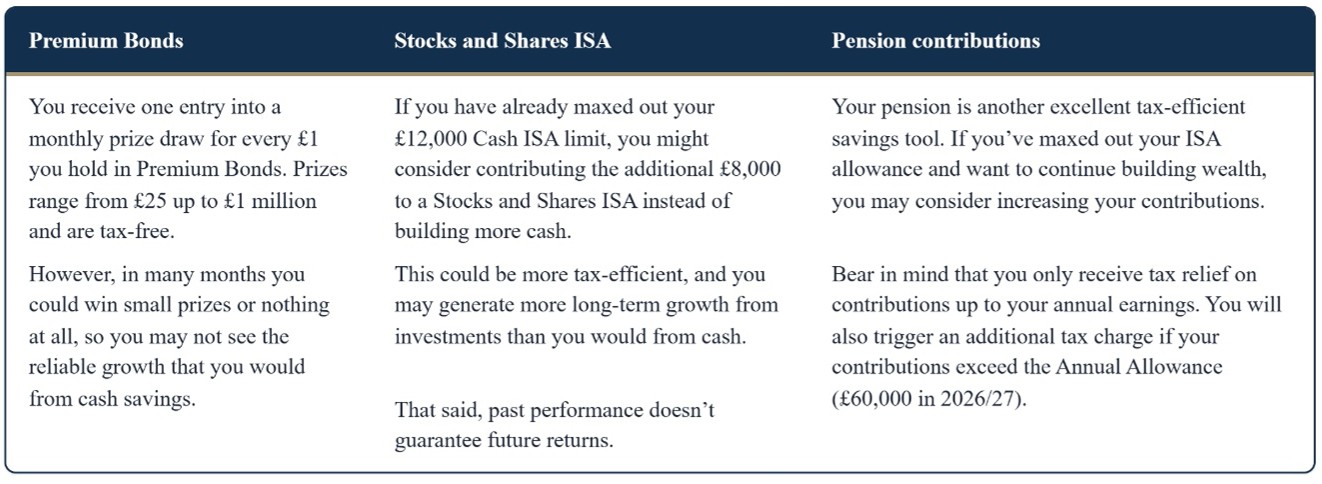
We can discuss which of these options is most suited to your unique situation and financial goals.
Get in touch
If you want to prepare for the Cash ISA changes coming in April 2027, please give us a call on 01276 855717 or email info@braywealth.com today.
Please note
This article is for general information only and does not constitute advice. The information is aimed at individuals only.
All information is correct at the time of writing and is subject to change in the future.
HM Revenue and Customs’ practice and the law relating to taxation are complex and subject to individual circumstances and changes which cannot be foreseen.
An ISA is a medium to long term investment, which aims to increase the value of the money you invest for growth or income or both. The value of your investments and any income from them can fall as well as rise. You may not get back the amount you invested.
Approved by the Openwork Partnership on 29/09/2026
 Production