
Inheritance Tax (IHT) has been in the news a lot in the past few years, particularly after the government announced important changes to the tax treatment of pensions on death.
As a result, you may be paying particular attention to how you can reduce what your family pays when you’re gone.
The executor of your will must add up the total value of your taxable estate, and then apply the nil-rate bands. In 2026/27, you have a £325,000 nil-rate band and may also benefit from the residence nil-rate band, worth up to £175,000 when passing your main home to a direct descendant.
Any portion of your estate that exceeds the nil-rate bands is normally subject to 40% IHT.
However, you might be unclear about what is included in the estate and how it’s valued.
Read on to learn more, so you can create an effective estate plan.
Major assets are considered part of your estate and valued individually
You may already know that your major assets are considered part of your estate for IHT purposes. This includes your:
- Properties
- Vehicles
- ISAs
- Cash savings
- Investments
The executor of your will must provide information about the value of these assets when filling out IHT forms. In some cases, this is straightforward as they can see how much is in your ISAs or savings and investment accounts.
Where properties or vehicles are concerned, your executor will likely need to have a professional assess the value. Bear in mind that it’s the current market value of the asset that matters, rather than the insurance or replacement value.
Smaller personal possessions may be valued collectively under the £1,500 rule
The contents of your home are also considered part of your estate, but there are specific rules about how smaller personal possessions are valued.
Any items worth more than £1,500, such as jewellery, antiques, artworks, or electrical items, must be valued and noted on the IHT forms individually. HMRC may require proof of the value of these items, so professional assessments may be needed.
Possessions that are worth less than £1,500 each don’t need to be valued individually; they can be grouped. However, the executor will still need to provide an accurate estimate of the total value of all these items.
If the executor can reasonably find information about the market value of items, they don’t necessarily need to get a professional valuation.
It’s worth considering these rules because, even if those smaller items seem insignificant, they could push the value of your estate up more than you realise once you add them all together.
For example, Aviva reports that, in 2025, the average value of the possessions in a UK household was £58,210.
Your pensions are exempt from your estate but only until April 2027
Certain assets aren’t considered part of your estate because they’re exempt from IHT.
The most notable example is your pension, but as you may know, this exemption will end from April 2027.
Read more: ‘3 tax changes coming in April 2027 and how you can prepare’
Your taxable estate could be considerably larger once this rule change takes effect and pensions are subject to IHT, so you may need to plan accordingly.
You might benefit from other important exemptions
Pensions aren’t the only asset that fall outside of the taxable estate and it’s important to take full advantage of any other exemptions.
You might benefit from:
- The spousal exemption – Any assets left to a spouse or civil partner are IHT-free. They also inherit your unused nil-rate bands, meaning couples could pass on up to £1 million between them without IHT.
- Charitable gifts – Wealth left to charity is immediately free of IHT. If you leave at least 10% of your baseline estate (after applying other exemptions and the nil-rate bands) to charity, IHT is payable at a reduced rate of 36% on certain assets.
- Business and Agricultural Relief – Business or agricultural assets with a collective value of £2.5 million fall outside of your estate. Any qualifying assets above this threshold receive 50% IHT relief.
Alongside these exemptions, there are some smaller items that might not be considered part of the estate for tax purposes.
For instance, items that are in the public interest, such as scientific collections, artworks, or historical archives, might be IHT-free. That said, strict rules apply and your family may need to display these items to the public; otherwise, they are considered part of the estate.
As you can see, the various exemptions that govern what sits in your estate can be very complex.
Gifts fall outside the estate provided you follow specific rules
Wealth that you gift to loved ones might not count as part of your estate, but this all depends on how much you give and when.
Only gifts that come under specific exemptions are free from IHT from the moment you make them.
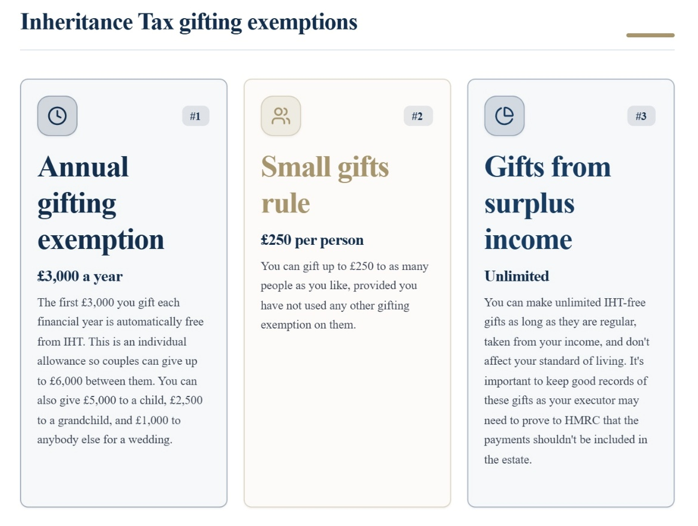
Gifts that fall outside these specific exemptions, known as potentially exempt transfers (PETs), may only be free from IHT if you survive for seven years after giving them. Should you pass away within seven years, these funds may still be part of your estate.
Seek professional advice to understand the true value of your estate
As you can see, calculating the value of your estate isn’t simple. There are many exemptions and rules to consider, and assets are valued in different ways.
To ensure that you have a clear picture of the true value of your taxable estate, and the IHT your loved ones could pay, it’s important to seek professional advice.
Get in touch
If you need guidance about estate planning, our expert team is here to help.
Please give us a call on 01276 855717 or email info@braywealth.com for more information today.
Please note
This article is for general information only and does not constitute advice. The information is aimed at individuals only.
All information is correct at the time of writing and is subject to change in the future.
HM Revenue and Customs’ practice and the law relating to taxation are complex and subject to individual circumstances and changes which cannot be foreseen.
The Financial Conduct Authority does not regulate estate planning.
Approved by the Openwork Partnership on 10/09/2026
 Production