
If you have been following the news, you are likely aware of the unfolding conflict in the Middle East and how this has affected the global economy. Markets around the world have dipped because of high oil prices, disrupted supply lines, and uncertainty about the future.
As an investor, you might wonder whether you should cash out of the market to protect your wealth from further falls. However, this may not be the most sensible course of action and holding your investments in the long term could result in higher returns overall.
To understand why this is, it’s useful to consider historical events, how markets reacted, and most importantly, what the recovery looked like.
Here are three important examples to consider.
1. The Wall Street Crash
The Wall Street Crash is perhaps one of the most well-known market downturns in history.
Throughout the 1920s, the US stock markets saw rapid expansion, and there was a rush to liquidate assets and invest heavily to benefit from this growth. Some investors borrowed money or sold assets to invest as much as possible.
However, much of the growth was fuelled by speculation and the expansion wasn’t sustainable. By September 1929, stock values had begun to fall. On 24 October – known as Black Thursday – the markets were in free fall and panicked investors were in a rush to sell.
According to Britannica, a record 12.9 million shares were traded on that day. The following week on Black Monday, the Dow Jones closed 12.8% down.
The next day, trades hit another record of 16 million, and the index lost a further 12%.
This volatility continued and led to the Great Depression, which lasted for around a decade until the onset of the Second World War.
Investors faced significant losses as a result of the Wall Street Crash, and it remains one of the most severe market dips in history. Despite this, the data shows that cashing out of the markets may not have been the best option.
Indeed, according to Schroders, investors who moved to cash after the 1929 crash would have had to wait 34 years before breaking even, compared with 15 years for those who stayed invested.
2. The 2008 financial crisis
The global financial crash in 2008 was another of history’s most prominent market upsets. Several banks around the world had to be rescued by governments to contain the worst effects of the crisis. Still, the crash led to widespread economic turmoil that took years to recover from.
On 31 December 2008, the Guardian reported that markets around the globe had experienced record falls in the past year. The FTSE 100 posted its worst year on record, losing 31.3% of its value in 2008. Global stocks, measured by the MSCI World index, fell by 44%.
However, figures from AJ Bell show that markets recovered and continued growing in a relatively short space of time.
Between 2007 and 2009, the FTSE 100 experienced a bear market, characterised by a prolonged period of decline. This ended on 3 March 2009, with the FTSE 100 down a total of 47.8%.
From this date, it took 1,764 days for the FTSE 100 to recover its value and continue growing.
This is just under five years, which may seem like a long time. But if you’re investing for your retirement and still have decades left before you finish working, five years is only a small portion of your investing timescale.
3. The Covid-19 pandemic
The Covid-19 pandemic was an unprecedented event in most of our lives. Economies around the world shut down almost entirely for an extended period, which had a marked effect on markets.
There was much uncertainty about when the world would return to normal and what the lasting effects would be on businesses. Many companies were unable to trade effectively and supply lines were heavily disrupted, too.
As a result of the lockdowns, global markets experienced an initial dip. However, the recovery was much faster than expected. This was partly due to the support that governments offered to businesses, but also because the development of a vaccine sparked hopes of a return to normality.
As a result, in 2025, AJ Bell reported that many major stock indices had posted significant gains since the Covid-19 pandemic. Their figures show:
- The Nasdaq had gained 106%
- The S&P 500 was up by 82%
- The FTSE 100 returned 18%
- Japan’s Nikkei 225 had grown by 66%.
So, although certain sectors were struggling with the recovery, markets were up overall and investors would have seen positive returns, despite the disruption caused by the pandemic.
Equity markets typically grow in the long term, despite any short-term falls
These historical events and the subsequent market recovery are not anomalies. In fact, historical data shows that stock markets typically recover from downturns in a relatively short time.
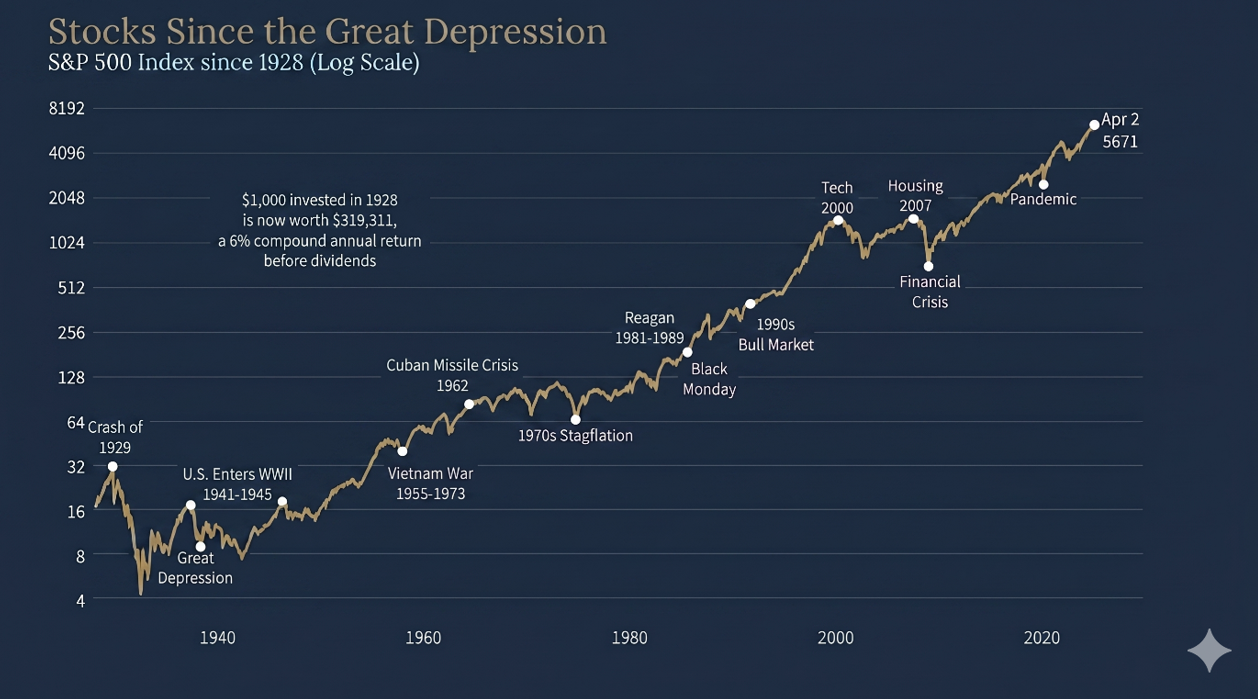
The following graph shows the growth of the S&P 500 since the Great Depression, with the various events that have disrupted markets along the way.
Source: Monevator
As you can see, while past performance doesn’t guarantee future returns, the markets generally trend upwards and crashes caused by world events are normally short-lived.
That’s why it’s important to shut out the noise and avoid making any rash decisions when you see the value of your portfolio fall. Instead, trust in your financial plan and hold your investments for the long term.
Get in touch
If you’re concerned about market volatility, speak to your financial planner for reassurance.
Please give us a call on 01276 855717 or email info@braywealth.com today.
Please note
This article is for general information only and does not constitute advice. The information is aimed at individuals only.
All information is correct at the time of writing and is subject to change in the future.
Past performance is not a guide to future performance and should not be relied upon.
The value of your investments and any income from them can fall as well as rise. You may not get back the amount you invested.
Approved by the Openwork Partnership on 01/05/2026
 Production